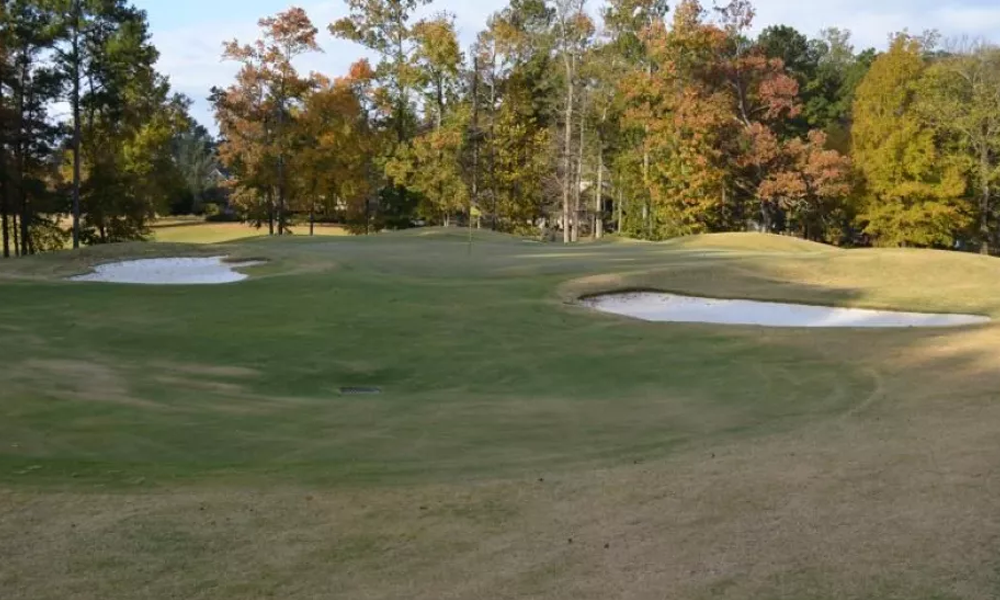
In the rolling terrain outside Birmingham, Alabama, Greystone Golf & Country Club’s Founders Course has established itself as a reliable championship venue on the PGA Tour Champions circuit. As host of the Regions Tradition, the course presents a consistent test of skill, one rooted as much in agronomic precision as in architectural intent.
For turf professionals, it’s a study in how design, climate, and management intersect during one of the most demanding windows of the growing season.
A Foundation Built for Championship Play
Opened in 1991, the Founders Course was designed by Bob Cupp in collaboration with Hubert Green, blending traditional shot values with a layout that rewards strategic execution.
Stretching beyond 7,200 yards, the course relies less on raw distance and more on positioning. Tree-lined fairways frame landing areas, while subtle elevation changes influence both ball flight and club selection. The greens, defined by internal contouring and runoff areas, place a premium on precise approach play and confident putting.
As Greystone expanded to a 36-hole facility with the addition of the Rees Jones-designed Legacy Course in 2000, the Founders Course remained the club’s competitive anchor. Today, as a member-owned club, Greystone reflects a long-term commitment to course conditioning and tournament readiness.
The Turf System: Built for Southern Conditions
The Founders Course operates on a warm-season turf platform designed to perform under both climatic stress and tournament expectations:
- Fairways and Tees: Hybrid Bermudagrass, providing durability and consistent lie quality
- Rough: Maintained in a denser Bermuda profile to create visual contrast and strategic penalty
- Greens: Champion Bermudagrass, selected for its fine texture and ability to deliver fast, uniform putting surfaces
Champion Bermuda is central to the course’s identity during tournament play, capable of producing firm, high-speed conditions while maintaining plant health through variable spring weather.
Agronomy in Transition
Preparing the Founders Course for the Regions Tradition places the maintenance team squarely in the Bermudagrass transition window, a period that demands precision and restraint.
Late April and early May in the Southeast present a narrow margin for error. Turf is emerging from dormancy and entering active growth, while weather patterns remain unpredictable.
Key agronomic challenges include:
- Managing rapid vegetative growth without excessive thatch accumulation
- Balancing soil moisture amid inconsistent rainfall
- Delivering consistent green speeds across contoured surfaces
- Minimizing stress to protect turf heading into peak summer conditions
Every decision, from fertility timing and irrigation scheduling to plant growth regulator use and mowing frequency, must support both immediate performance and long-term turf health.
Leadership and Continuity
Travis Cook, who became superintendent in 2021, played a significant role in shaping the Founders Course’s modern agronomic program during its evolution as a PGA Tour Champions venue. His tenure helped establish a framework for consistency, performance, and sustainable turf management.
Today, that program continues under superintendent Hunter O’Mary, reflecting a smooth transition in leadership and a sustained commitment to championship-level conditions.
Across the property, Greystone’s agronomic depth is further supported by Russell Wallace, superintendent of the Legacy Course, reinforcing a multi-course operation built on experienced turf management and internal development.
Tournament Conditioning: Firm, Fast, Consistent
For the Regions Tradition, course conditioning follows a clear and disciplined objective: firm, fast, and predictable surfaces.
- Greens are prepared to achieve championship speeds while preserving plant integrity
- Fairways are managed to promote ball roll without sacrificing density
- Rough is maintained to provide definition and strategic challenge
The finishing stretch, particularly the par-5 18th, showcases the interaction between turf conditions and design intent. Firm landing areas, tightly mown surrounds, and subtly contoured greens create an environment where execution is dictated as much by surface conditions as by shot selection.
A Model of Modern Turf Management
What distinguishes Greystone’s Founders Course is not a single defining feature, but the consistency of its agronomic execution. The course operates as a fully integrated system, where inputs are carefully calibrated to deliver reliable playing conditions under tournament pressure.
For superintendents and turf professionals, the Founders Course offers a clear takeaway: championship conditions are not created in a single week of prepparation, but through year-round discipline, informed decision-making, and a management strategy that balances performance with plant health.
At Greystone, the result is a course that doesn’t just host competition, it sustains it.