There is a difference between maintaining a golf course and truly understanding what is happening beneath your feet.
For golf course superintendents, daily decisions often revolve around familiar routines: mowing, rolling, watering, topdressing, and aerating. But what happens when those routines are examined more closely? What can a soil sample reveal about years of maintenance? Why does a putting green behave differently in May than it does in August? And could a practice intended to improve turf conditions temporarily move a playing surface further from its desired performance?
These are the kinds of questions Chris Tritabaugh has been exploring in a recent series of posts on his ct_turf Substack newsletter. His observations offer a valuable reminder that some of the most useful discoveries in turf management begin with something simple: curiosity.
Curiosity Is a Management Tool
After stepping away from regular writing in late 2024, Tritabaugh recently returned to sharing his observations about turfgrass management.
The break was understandable. His responsibilities included overseeing significant golf course developments, expanding highly maintained acreage by approximately 24 acres, adding nearly 1,000 irrigation heads, and preparing for major championship events, including the 2024 U.S. Amateur and the 2026 KPMG Women’s PGA Championship.
Now, with renewed interest in documenting what he sees, Tritabaugh is returning to a habit that has long shaped his approach to turf management: observing, questioning, thinking, and learning.
For superintendents, that mindset has practical value. Maintenance programs are built on experience, but experience becomes even more useful when familiar results are questioned rather than simply accepted.
A superintendent who notices an unusual soil profile, an unexpected change in surface firmness, or a seasonal difference in putting quality has an opportunity to investigate the underlying cause.
Not every observation produces an immediate answer. Sometimes the value lies in recognizing that a question deserves further attention.
The Story Hidden in a Soil Sample
One of Tritabaugh’s recent observations began with something most superintendents encounter regularly: soil sampling.
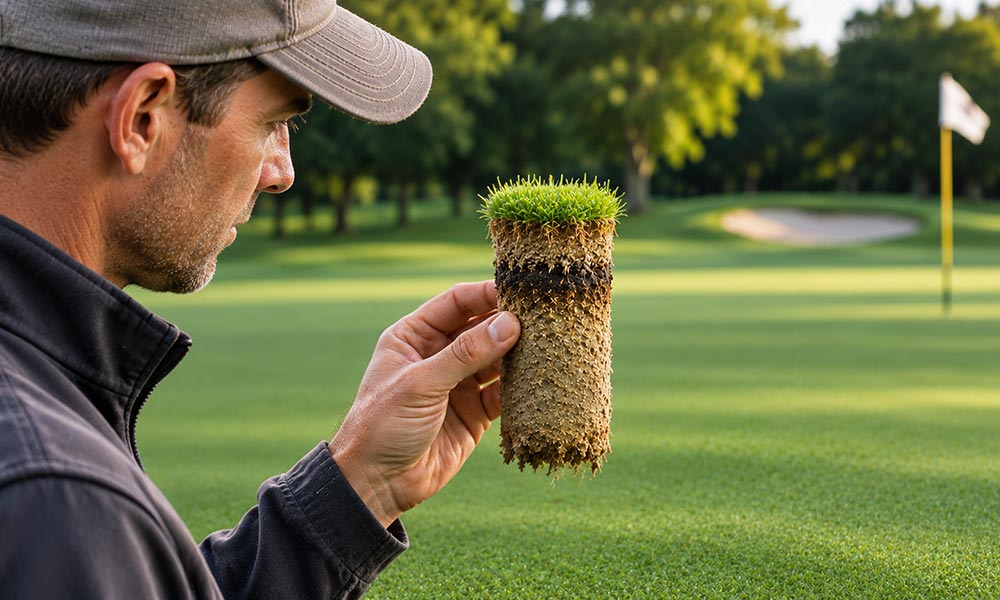
While preparing 64 annual soil samples, he noticed an unusual feature in cores collected from tee boxes. Approximately half an inch beneath the surface, a distinct band of organic matter appeared to have shrunk as the samples dried.
The observation raised several questions.
Could the organic matter have developed differently from material that did not exhibit the same shrinkage? Was the condition related to the moisture content when the samples were collected? Did the drying process influence what he was seeing?
Tritabaugh did not claim to have the answers.
That uncertainty is precisely what makes the observation interesting.
Soil cores can preserve evidence of previous management practices, including accumulated organic matter and sand topdressing. In this instance, the visible layers offered an opportunity to consider how years of maintenance might have influenced the profile.
For superintendents, the broader lesson is that soil sampling does not have to be limited to laboratory results. Examining the physical characteristics of a sample can generate questions about drainage, organic matter development, moisture behavior, and maintenance history.
A soil core is more than material collected for testing. It can also provide a visual record worth investigating.
Why Bentgrass Greens Behave Differently in Spring
Another of Tritabaugh’s observations focuses on a challenge familiar to northern golf course superintendents: achieving consistent putting performance during spring.
As temperatures rise and cool-season grasses resume active growth, creeping bentgrass begins preparing for seed production. Although regular mowing prevents seedheads from fully developing on putting surfaces, the plant’s physiological response still influences its growth characteristics.
The result can be a noticeably coarser surface texture during the early growing season.
That texture matters.
Tritabaugh explains that a spring putting green may require substantially more mowing and rolling to achieve performance comparable to a green later in the summer.
In his experience, a surface that responds well to one mowing and rolling operation in late August might require three mowing operations and a rolling operation in late May to produce a similar result.
The difference is not necessarily an indication of poor maintenance. It reflects the changing biology of the turfgrass plant.
Using seasonal green-speed measurements, Tritabaugh illustrates how putting performance develops throughout the growing season and how weather interruptions can complicate that progression.
During preparations for the 2026 KPMG Women’s PGA Championship, his team placed particular emphasis on maintaining sufficient mowing and rolling frequency to overcome stubborn spring texture.
The lesson extends beyond tournament preparation.
Understanding seasonal plant behavior allows superintendents to establish realistic performance expectations, adjust maintenance intensity, and explain why achieving a desired putting speed may require different approaches at different times of the year.
Aeration: What Happens When You Make Holes?
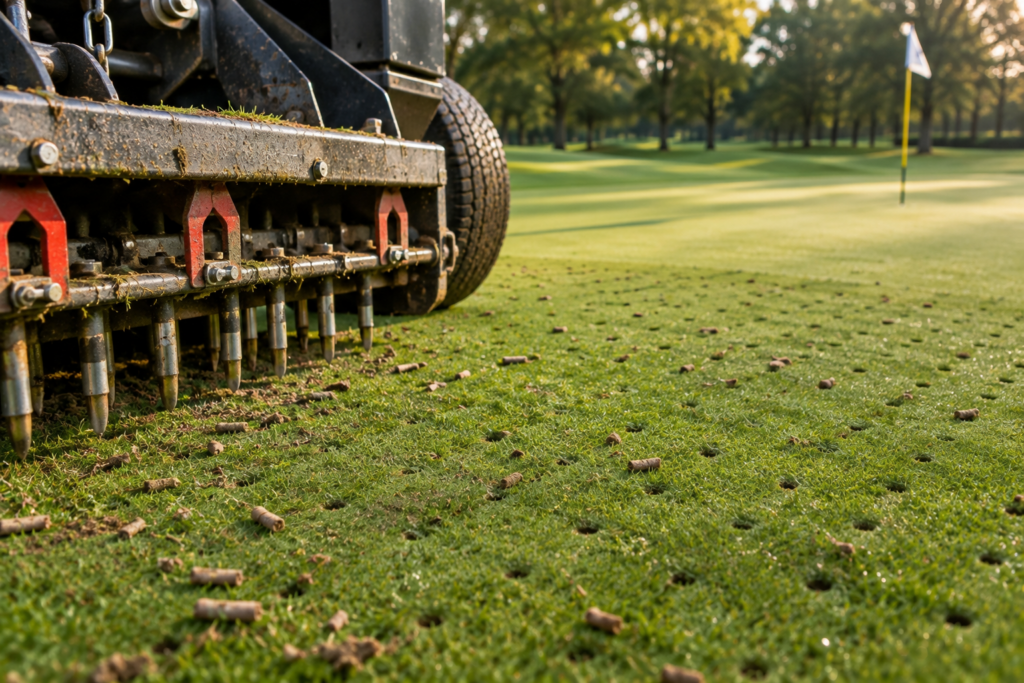
Perhaps the most immediately applicable observation in Tritabaugh’s recent writing concerns aeration and putting surface firmness.
Aeration is one of the industry’s most established cultural practices. It can relieve compaction, improve growing conditions, and address specific root-zone concerns.
But it also changes the playing surface.
Tritabaugh examined Tru-Firm measurements collected during the 2025 and 2026 growing seasons to better understand those changes.
His 2025 measurements showed a general increase in putting surface firmness from spring into September, with fluctuations associated with precipitation and irrigation.
Following a late-September micro-coring operation, firmness dropped noticeably and did not return to its pre-aeration level during the remaining measurement period.
The 2026 data provided another opportunity for comparison.
Tritabaugh evaluated three different putting surfaces: championship course greens, short-course greens, and a large practice putting green.
The championship greens, which were not aerated during the period examined, generally became firmer as the season progressed.
The other surfaces experienced aeration events, and the resulting reductions in firmness were evident in the measurements.
In the cases he documented, recovering to approximately normal firmness took about a month.
These observations raise an important management question: If firmness is a primary performance objective, how should aeration frequency be evaluated?
Tritabaugh is careful not to suggest that aeration is unnecessary or inherently detrimental. Rather, his findings demonstrate that a beneficial cultural practice can also produce measurable, sometimes undesirable, short-term changes in playing conditions.
That distinction matters.
A maintenance practice should be evaluated not only by what it accomplishes below the surface but also by how it affects the playing experience above it.
Measure First. Understand More.
The common thread running through Tritabaugh’s observations is the importance of connecting curiosity with measurement.
A soil core prompts questions about organic matter. Seasonal texture changes explain differences in maintenance requirements. Firmness measurements reveal the consequences of aeration practices.
Each observation becomes more useful when supported by consistent records and a willingness to reconsider assumptions.
For superintendents managing increasingly demanding playing conditions, that approach offers an important advantage.
Rather than relying exclusively on traditional schedules or familiar maintenance routines, data can help identify when a practice is necessary, how frequently it should be performed, and what effect it has on the finished product.
Just as importantly, it can reveal unexpected relationships that might otherwise go unnoticed.
The Value of Asking Why
Golf course management combines science, experience, observation, and judgment. No single measurement can explain every condition, and no maintenance program is universally appropriate.
What Tritabaugh’s recent writing illustrates is that curiosity remains one of the profession’s most valuable tools.
The next meaningful discovery may not require new equipment, an expensive research project, or a complete change in maintenance philosophy.
It may begin with examining a soil core more closely, questioning why a green performs differently from one month to the next, or comparing firmness measurements before and after a routine cultural practice.
For superintendents willing to look beyond the routine, the golf course itself offers a continuing opportunity to learn.
And sometimes, the most productive question is simply: Why?
About the Source
This article draws on observations and firsthand turf management experiences shared by Chris Tritabaugh in his ct_turf Substack newsletter. Golf Course Trades has independently summarized and connected these observations for its readers.
Read Chris Tritabaugh’s original posts:
- Habitually Curious — November 11, 2026
- A Curious Photo — November 12, 2026
- Turfgrass Texture — November 16, 2026
- What Happens When You Make Holes — November 19, 2026