[AUTHOR’S NOTE: Back in the April 2021 issue of Golf Course Trades (see https://golfcoursetrades.com/doctor-turfgrasss-richard-hurley/), we caught up with Dr. Richard Hurley, a.k.a. Dr. Turfgrass, the scientist behind nearly every great advancement in turfgrasses for the last 50 years. By request of our readers, we reached out to Dr. Hurley for an update on all his latest projects on and off the golf course.]
AGENT JAY: Strangely enough, when we last talked to you, it was at New Jersey’s Bayonne Golf Club, just across the river from Manhattan. And now, as it happens, you’re at Bayonne again.
DR. TURFGRASS: That’s right, Jay. I am the honorary tournament chairman for the inaugural NCAA Harbor Cup invitational, a nine-team college tournament hosted by Rutgers University and held at Bayonne. The nine teams are Rutgers, Little Rock, West Virginia, Kansas, Nebraska, Purdue, Michigan State, South Florida, and Marquette.
AGENT JAY: Tell us more. What did tournament chair duties entail?
DR. TURFGRASS: I was the honorary chair because of my relationship with Rob Shutte, coach of Rutgers golf.
AGENT JAY: That’s also where you teach turfgrass sciences, isn’t it?
DR TURFGRASS: For 30 years! And for a few of those years now, Rob and I talked about having an NCAA tournament that Rutgers could host that would be prominent, prestigious, and well-received. I approached Eric Bergstol, my friend who owns and who designed every inch of grass and every brick and stone at Bayonne Golf Club. Eric was excited and that was the start.
Eric and Rudy Virga the club manager not only gave the okay, but were integral in organizing it, along with Head PGA Golf professional Chris Billington. Along with the Bayonne team, much of the heavy lifting was done by Rob and the Rutgers Athletic Department staff. We also had a group of Rutgers alumni raise over $100,000. Morgan Stanley was the primary sponsor.
We wanted the player experience for the participants to be second to none, so all the golfers were put up in hotels in Lower Manhattan and then ferried to the golf course each morning for the competition in the club’s private ferry.
AGENT JAY: I bet you were everywhere at once, both in the lead up to the event and during the week of play.
DR. TURFGRASS: You’re right. I was involved in both planning and ceremonies during the event like presenting the trophy to the winners and medalist. One day I’d be seeing to food and beverage, the next I’d arrange the entertainment. At all times you’re handling the communications team: there is so much to do to coordinate nine teams from around the country and get them from, say, Manhattan, Kansas to Manhattan, New York. And on tournament days, handling the scoring was probably my foremost duty. But together we pulled off a fantastic tournament. You should come cover it next year.
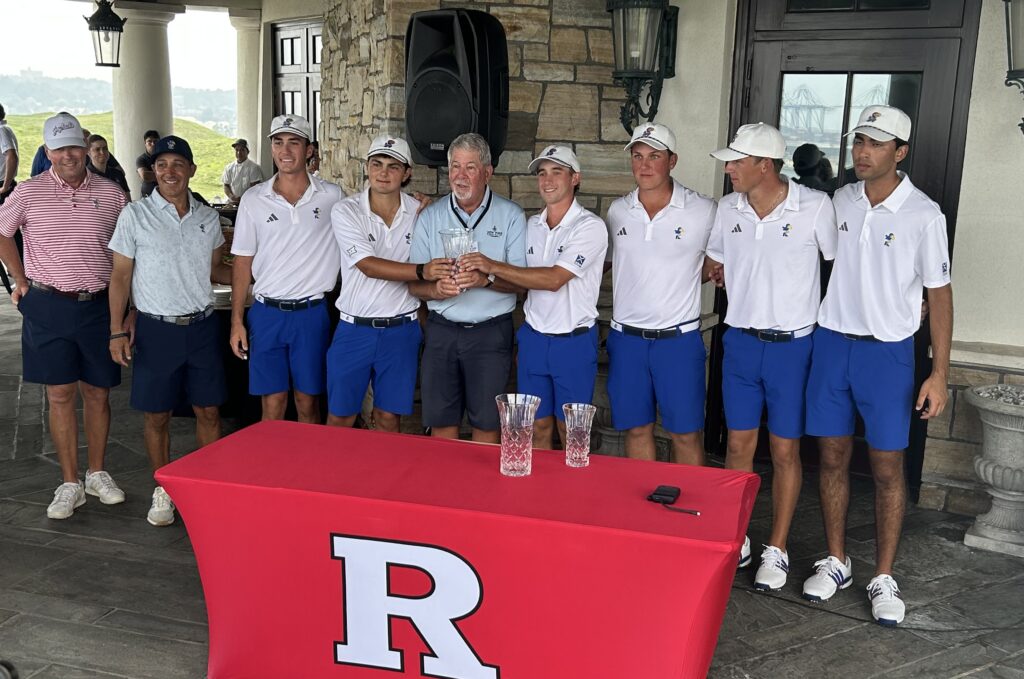
AGENT JAY: You hear that, readers? We have an assignment for that week. Nowe tell us about the competition? [Author’s Note: The Kansas Jayhawks went wire-to-wire, finishing the three day tournament 25-under to Purdue University’s 23-under. Little Rock and Michigan State finished a distant tied for third at 11-under. Host Rutgers finished 5th out of the nine teams at 6-under.]
DR. TURFGRASS: It was strong. Kansas won by two strokes over Purdue. Two of the top three finishers were from Kansas. On day one, they fired a four man combined 15-under, including a 63 b y the overall medalist.
AGENT JAY: Kansas got a lot of mileage out of their opening day. They were eight shots clear of their nearest competitor…
DR. TURFGRASS: They did, but Purdue nearly turned the tables on day three, but they just couldn’t quite catch the Jayhawks. You have to see these kids hit the ball. Every one of them hits it over 300 yards, and they have all the shots. Moreover, these kids made every three to five foot putt all day long on the greens. Both the field and the quality of golf were really strong.
AGENT JAY: We wrote about Bayonne back in the July 2017 issue of GCT. (see https://golfcoursetrades.com/bayonne-golf-club-a-shangri-la-of-golf/). There were some recent changes to the front nine in particular that were implemented just this season. Tell us about the how and why of the changes, and how the new holes played for the tournament.
DR. TURFGRASS: The greens were seeded originally in 2005 when the course was built. We wanted to thicken them, yet keep them in tournament shape. So about 18 months ago, we changed out the old grass strain, stripping all the turf off all 18 greens, and replaced them all with my 007XL strain.
AGENT JAY: Aha! The current standard in the industry.
DR. TURFGRASS: Yes, it was…at that time. Here we are 18 months later, and the greens were perfect! No ball marks, every blade uniform, no spike marks late in the day, just an impeccable playing surface. The players, coaches and members all raved about it.
Eric also wanted to make changes to the front nine – particularly at four, six, and nine.
AGENT JAY: The goal was to make the start of the golf course tougher. There are also changes to the second green complex.
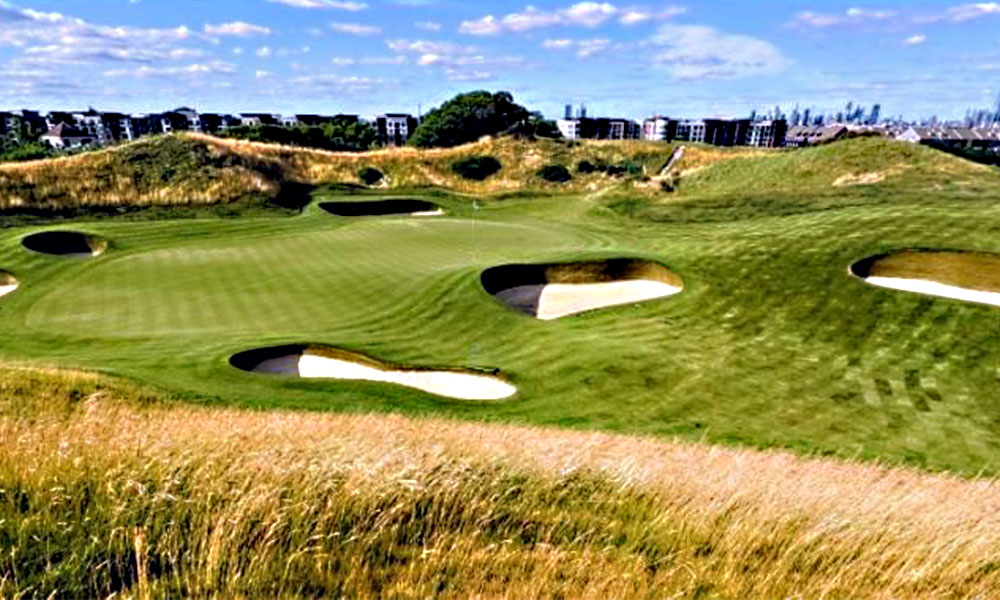
DR. TURFGRASS: That’s right. At the ninth, Eric rebuilt the entire green complex and the surrounds, adding stacked, sod-faced bunkers greenside, but eliminating the cross-hazard that used to bisect the fairway. The approach on four now has a lower fairway so you see the green better, but there are new bunkers on the sides and behind. At six, he did the reverse, putting in a new stack bunker in front of the green.
In fact, all the bunkers at Bayonne are Scottish style, stacked, sod-faced bunkers. A few years ago, I taught Eric a synthetic way to do it.
AGENT JAY: A synthetic way to build a bunker? How?
DR. TURFGRASS: You buy these astroturf pieces cut into small dimensions and you stack those on top of one another instead of natural sod. Yes, it’s artificial, bit it lasts a long time, a lot longer than natural sod.
AGENT JAY: That’s true. You have to replace sod faced bunker faces every three to four years if you really want to keep the faces in top condition.
DR. TURFGRASS: Yes, you’d have to. We went to south Florida to look at some courses that used this system – maybe Medalist was one – and so we built these at Bayonne over the last three years.
AGENT JAY: How is our good friend Eric Bergstol, the genius behind the design, construction, and operation of Bayonne?
DR. TURFGRASS: Eric was there all day Sunday for the practice round and the welcome dinner for all the athletes and coaches at the club. Eric gave a wonderful address along with the Rutgers athletic director, Kelli Zinn. She was also the AD at LSU.
AGENT JAY: How did Rutgers steal her?
DR. TURFGRASS: A year and a half ago the president of Rutgers stepped down. They did a search and got their new president from LSU. He brought Kelli with him. Now get this for lucky: she’s originally from West Virginia, and she worked there with a fellow named Todd Kingsley. Later in his career he went to Ohio State, and he was in charge of NIL $$ there, but when Kelli got the job at Rutgers, she drew Todd to Rutgers along with her.
AGENT JAY: So what’s next for you Dr. What have you been up to besides shaking hands and kissing babies at golf tournaments?
DR. TURFGRASS: I have a new bent grass! The nest great step. It’s called ULTRA 7, my newest bent grass that follows the others. We had 007, then 777 then 007XL and now this – ULTRA 7.
AGENT JAY: DO YOU MEAN TO TELL ME I’VE BEEN INTERVIEWING YOU FOR 75 MINUTES AND ONLY NOW DO YOU GET AROUND TO TELLING ME ABOUT YOUR NEW GRASS STRAIN??!!
DR. TURFGRASS: (laughter) 1,000 apologies…
AGENT JAY: What is the improvement or innovation in this new strain?
DR. TURFGRASS: I am working on it with Dr. Stacy Bonos of Rutgers. The biggest advancement is in genetic resistance to diseases, specifically the dollar spot disease and the ANPHRACNOSE disease. Now superintendents can expect to save anywhere from 50-75% on fungicide use compared to what they are using with older turf. Those figures have been documented by Rutgers U. research conducted by Dr. Bruce Clarke and Dr Jim Murphy.
That’s a big deal because genetic resistance will reduce pesticides, and that’s always been a goal of my research and the Rutgers breeding program.
AGENT JAY: ULTRA 7 – I’ll look for it. The next great advancement in turfgrasses. Coming soon to a course near you.