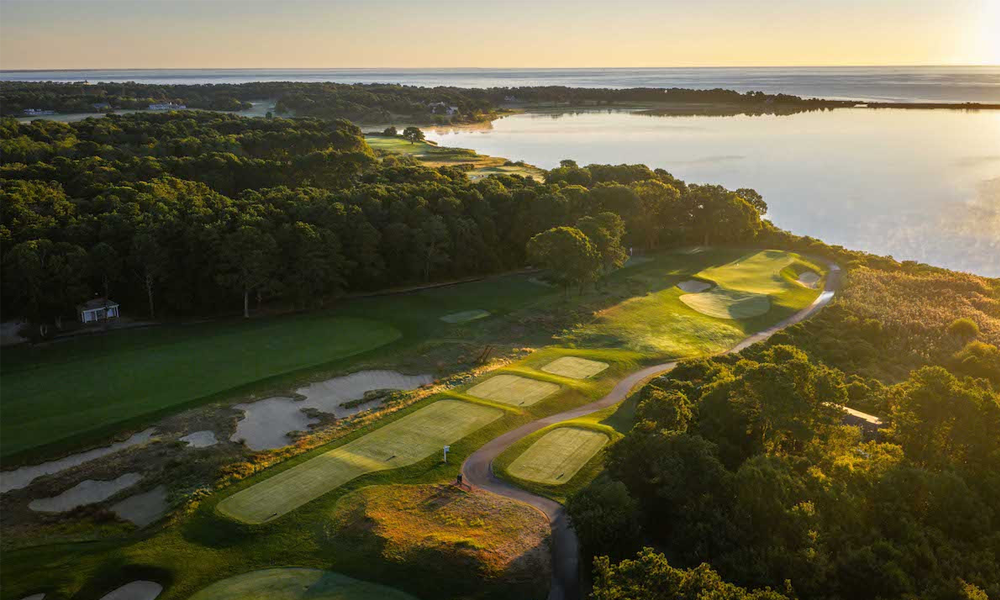
Despite its rarefied, coastal location and robust membership rolls, newly renovated Farm Neck Golf Club remains a public course, open to visiting golfers year ‘round. Still, the club isn’t coy about its seasonal priorities: In July and August — when members dominate the tee sheet and Martha’s Vineyard is similarly jammed with summer folk — public tee times are scarce and among the most expensive in American golf.
In the Spring and Fall, however, tee-time availability goes up and green-fee prices plummet. What’s more, September and October at Farm Neck GC remain the most beautiful, temperate times to play golf on the island. Even the members will admit to that.
“That was true 20 years ago, before the climate got warmer, so it’s more true today,” explains General Manager Tim Sweet. “There’s no mystery to what we’re trying to do here at Farm Neck: We price our golf in September and October to better attract public play — same for May and June, which are equally spectacular weather/golfing months out here.
“I’ve lived on this island 50 years. We locals understand why the popularity of Martha’s Vineyard is so concentrated in July and August. The mystery is why it’s nowhere near that crowded in September — or May. The off-season golf and weather here have never been better. It’s just way more affordable compared to high season, which goes for accommodations and pretty much everything else on the Vineyard.”
Farm Neck GC has certainly never looked or played better than it does today, thanks to Mark Mungeam’s comprehensive renovation, completed in spring 2025. In many ways, the architect has led the club back to its distant roots.
These 18 holes occupy an enormous, ecologically diverse footprint on the north shore of Martha’s Vineyard, some 425 acres in all. In the late 19thcentury, when Oak Bluffs was a quaint collection of Victorian summer cottages, Cottage City Country Club first took shape at the north end of the property. Scottish architect Alexander Finley formalized the layout in 1900. The venture changed names and ownership several times through the mid-20thcentury before finally petering out in the late 1960s.
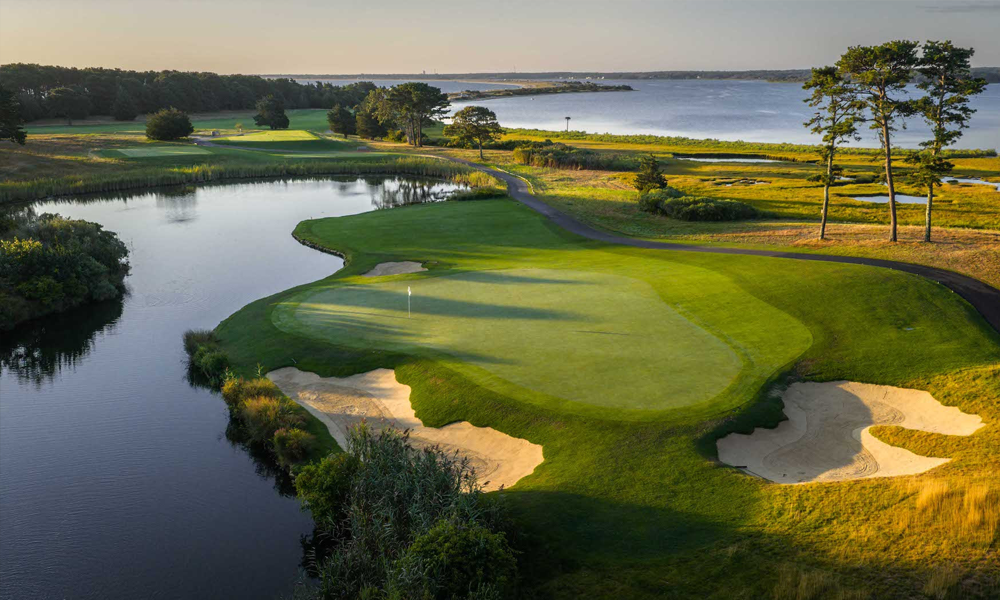
The original nine at Farm Neck GC — designed by Mungeam’s mentor and former partner Geoffrey Cornish — debuted in 1976, along the saltwater shores Sengekontacket Pond. These holes occupy the south-lying portion of the property, meaning they don’t follow the historic Findlay routing at all. Three years later, nine more holes (designed by Patrick Milligan) opened on and around the original Cottage City golfing ground, though just one modern hole, the par-4 14th, follows that routing.
Mungeam’s ingenious refurbishment unified a design that had never quite synched up stylistically. The result? One the elite public courses on East Coast. With the Atlantic Ocean visible on 10 separate holes, Farm Neck also stands among the most scenic tracks in the country, public or private.
This transformation took more than a single renovation. In 2013, Mungeam had refurbished all 18 greens and removed hundreds of trees. His recent work removed hundreds more, effectively replacing a parkland vibe with the island’s native sandplain grassland habitat.
Farm Neck’s new, colorful array of sand and scrub provides more than aesthetics. They take the routing back in time. Mungeam and the team from MAS Golf Construction mined all corners of this ancient golfing ground for its cache of native grasses. Once replanted, they accent portions of all 18 fairway corridors and green complexes.
“Fifteen months after reopening, those fescues, sedges and blue stems have really come into their own,” reports Mungeam, sitting president of the American Society of Golf Course Architects. “That was the point of transplanting native grasses from elsewhere on the property — they’re native. We knew they’d thrive.
“But we went to that trouble because they also unify the 18 holes and underline the seaside nature of this property. In July and August, these natives are long and golden, and they certainly wave gracefully in the coastal breeze. But come September and October, they turn purple and cinnamon, with plenty of gold strands set beside 10 different shades of green and blue. You don’t get that sort of color in the summer months. And if you like hard-and-fast playing conditions, you cannot beat island fairways and greens in the fall, when the bentgrass starts to harden off.”
Mungeam’s canny blend of style and strategies, his seasonal leveraging of native flora, are two reasons why GolfInc listed Farm Neck among its Renovations of the Year for 2026.
Of course, Martha’s Vineyard is chock full of similarly spectacular, shoulder-season delights. Start with the other public courses on the island: the sterling, Wayne Stiles-designed nine at Mink Meadows GC and the one-and-only Royal & Ancient Chappaquidick Links — in addition to all the Cape Cod tracks one must pass in order to board the ferry at Woods Hole (or New Bedford). Their offseason rates are a bargain, too, though maybe not quite on the order of a round-trip on JetBlue from JFK, which, in early October, is one third the price of an August ticket.
AirBnB and VRBO rates also go way down in should seasons, the Farm Neck GM confirms. Considering a couples trip? Check out the MV International Film Festival in Vineyard Haven, Sept. 8-13. If you stay here in Oak Bluffs, the Martha’s Vineyard Songwriter’s Festival (Sept. 17-20 at the Strand Theater) is walkable — from the ferry, from Farm Neck GC, from dozens of first-rate restaurants, all of them eager to welcome off-season folk.
Even if tourist traffic drops precipitously after Labor Day, Sweet urges any and all visitors to leave their cars at home. Ride-shares from the ferry or airport make eminent sense, all year long, as do bike rentals the rest of your stay.
“It’s another world out here in the shoulders seasons,” says Sweet. “It’s another world still, come the winter. But I wouldn’t recommend that. Like many islanders, we here at Farm Neck take the winter off.”