This column features recollections of the author’s 38 years as a golf writer. These installments stem from his many travels and experiences, which led to a gradual understanding that the game has many intriguing components, especially its pekople.
The most remembered passage in mystic poet William Black’s famous “Tyger” is: “Tyger Tyger burning bright.”
Eldrick “Tiger” Woods has not competed since the 2024 Open Championship. Despite that, the golf media’s relentless obsession with him leads me to paraphrase Blake’s 1793 verse: “Tiger Tiger STILL burning bright.”
Woods burst onto the world’s radar in 1991 with the first of his three straight U.S. Junior Amateur titles, followed by three consecutive U.S. Amateur victories. His record-setting 12-stroke victory in the 1997 Masters at age 21 permanently set the entire golf world atwitter. Not only did Woods reveal a whole new way to play the game, this charismatic, ultracompetitive athlete with a Thai mother and black father altered the world’s perspective of it.
Thirty-five years later, Tiger remains the polar light for golf writers and his name still generates ad revenues. If the news cycle goes lacking, the auto fallback story is about him. For this column I tested Google’s AI algorithmic capability by requesting the total number of stories in Woods’ lifetime. It gagged, before spitting out a vague “countless thousands of magazine profiles,” and then a vacuous “it ranks among the highest in sports history.”
Virtually anything non-golf Tiger has done is also broadcast – divorces, car crashes, hangnails, self-inflicted injuries and whatever else he says/supports/dislikes/does – ad nauseum.
As if Tiger omniscience isn’t enough, new media blasts about his and Rory McIlroy’s new made-for-TV circuit TGL, and son Charlie Woods. Every move Tiger and his kid do is blared in print and electronic media. Latest headlines: “Tiger may [please, please, please!!] play in the Masters!” and “Charlie picks Florida State and not his dad’s Stanford!”
Harkening Backward . . .
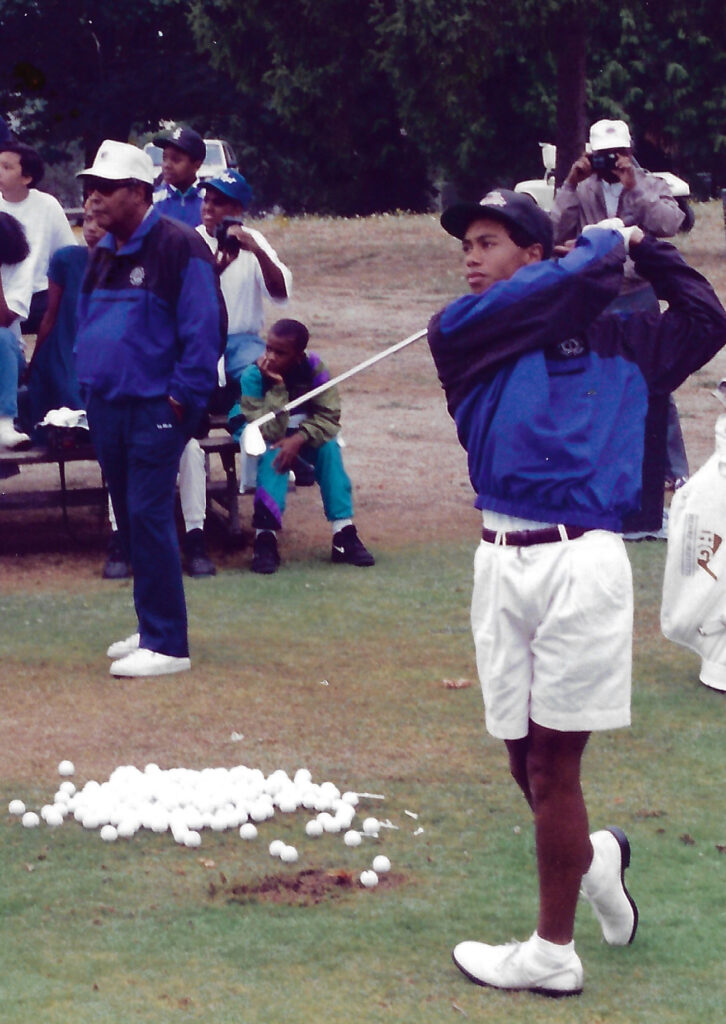
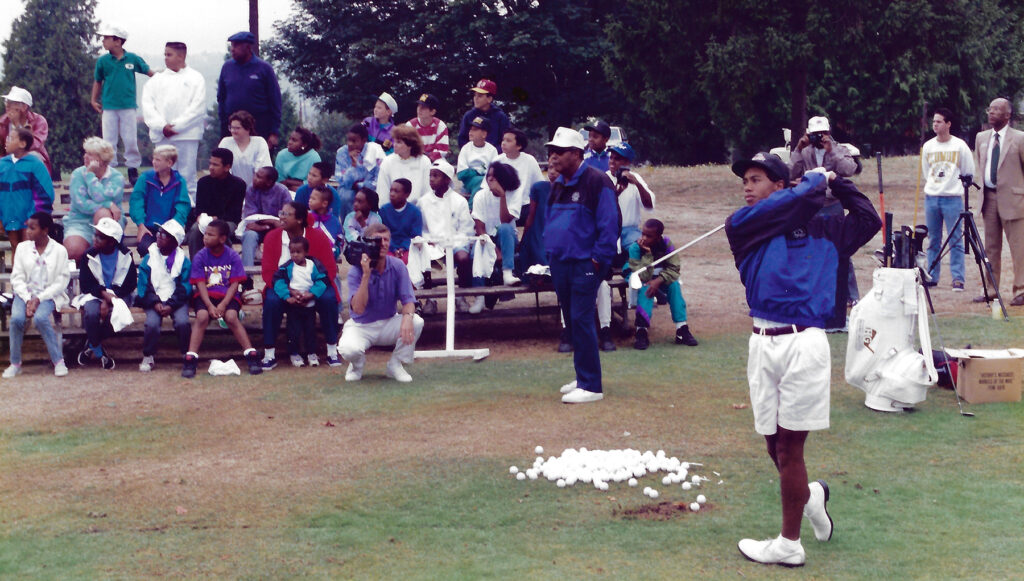
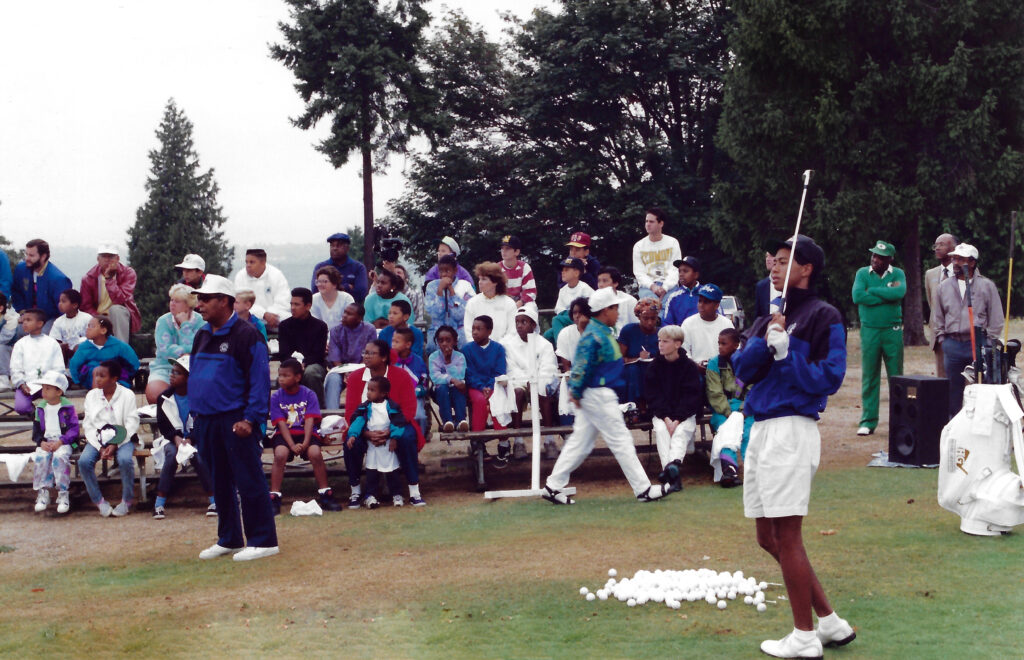
I much prefer recalling my low-key experience with a 15-year-old Tiger in 1992, a year after his first big amateur title. I met him and dad Earl in Seattle at an exhibition staged for a hundred or so inner-city kids and adults on the rough-hewn par-3 course at Jefferson Park’s 27-hole facility on Beacon Hill east of downtown.
The event at Jefferson Park was hosted by the venerable Fir State Golf Club (https://firstategolfclub.com/). Fir State was established there in 1947 – a time with racial restrictions throughout this stereotypical ultra-liberal city – to ensure that all races have access to public golf.
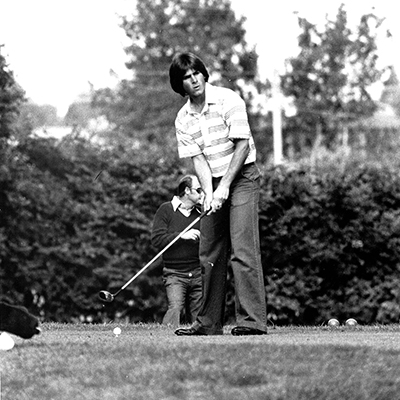
Jefferson’s 18-hole course was also Fred Couples’ training grounds; his father worked for the parks department and the family lived nearby. The adult and mainly black Fir State members helped teach a very young and virtually penniless Freddie a thing or two about betting and performing under pressure.
At the time of the Woods’ visit, I was on the board of the Municipal Golf Advisory Committee (MGAC), a small disparate group of citizens – including Fir State representatives – empowered by the Seattle Parks Department to study alternatives for the green fee-sucking concessionaire system in place at the time.
In the late-1980s and early ‘90s, the city’s three courses were bursting with golfers, generating a total of about $4 million a year. But the courses still had a $600,00 annual deficit with the program and very little of the revenue was invested in improvements. The municipal golf courses were treated as cash cows by the city and their avaricious operators. Teeing off raised rubber mats every hole on the combined 72 holes at Jackson Park, Jefferson Park and West Seattle GCs advertised where you regularly played because of the black streaks on the soles of your clubs.
[Upshot of the MGAC: After two years of myriad meetings and often-contentious community outreach sessions attended by dozens of vocal supporters and naysayers, we ultimately succeeded, receiving official approval for a nonprofit management system. We had great hopes for major reinvestments in the courses and a ray of hope for these downtrodden tracks. Sadly, soon after our group was unceremoniously dumped and replaced by a bloated – 21 members on their board! – nonprofit regime that was badly mismanaged and self-imploded.]
Fir State invited Tiger and Earl to show 100 or so kids, adults and the city’s mucky mucks a different view of golf: that of a game any player could excel if given the opportunity.
At this low-key exhibition, the quiet and shy Tiger hit a variety of shots. Earl did all the talking and gave his son instructions over a long-corded microphone and loudspeakers while walking farther into the course. Set up at the far northwest corner beside the kids in grandstands, Tiger hit balls diagonally over the squarish 10-acre, 1,225-yard layout. It was immediately clear this youngster was a genius, expertly hitting draws and fades to almost the exact yardage his father called out. It was like watching a young, black version of Ben Hogan.
Starting with a pitching wedge, Tiger advanced through to his longer clubs. The kids oohed and aahed as golf balls whistled off the clubface. Finally, after launching a few 2-iron lasers, from 150 yards away Earl hollered, “Hit your driver!”
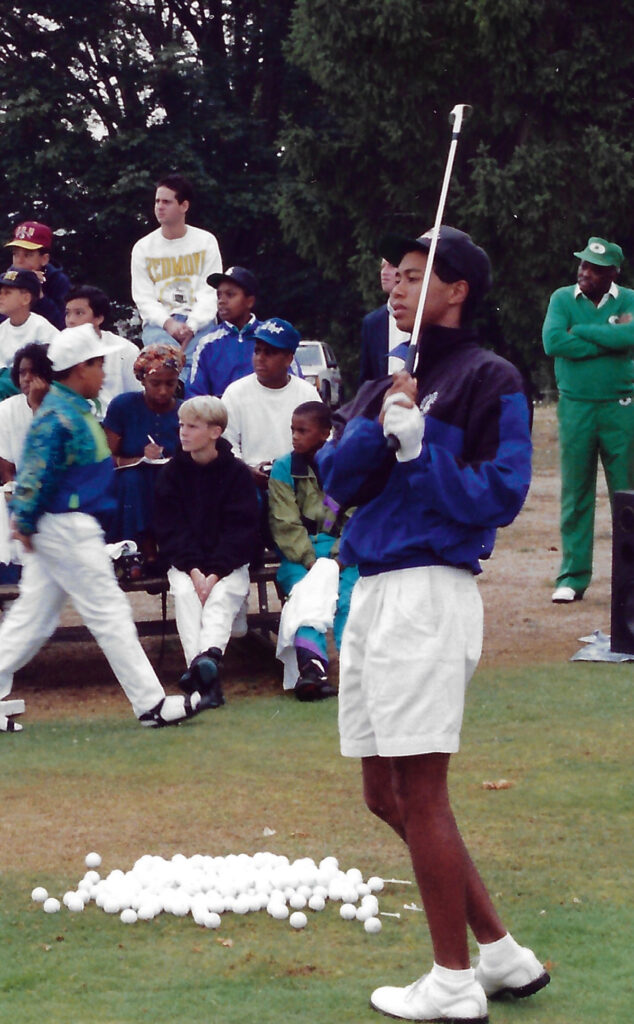
Tiger dutifully took out the big stick. But when three straight balls clanged off cars parked around 300 yards away on nearby Beacon Avenue, his animated father began waving his arms and, running toward his son yelled: “Stop, stop, stop!!!” The exhibition ended on this memorable note. I could tell that Tiger, by then smiling and more animated, was just getting warmed up and wanted to show more to the young and exuberant, multi-colored audience. Afterwards, father and son stuck around to sign autographs and mix with the crowd before heading to the airport.
It’s worth noting that that Tiger was a lean 6’1”, about the same height as he is today. He was 150 pounds and incredibly flexible, smooth and powerful. In other words, blessed with the perfect golf swing for a supernaturally gifted athlete. Since then, I’ve always wondered: What would have happened (20 majors instead of the 15 he’s frozen at?) if he had stayed near that weight and hadn’t later gotten into that body-breaking strength training and weightlifting nonsense.
Meanwhile . . . in Other News
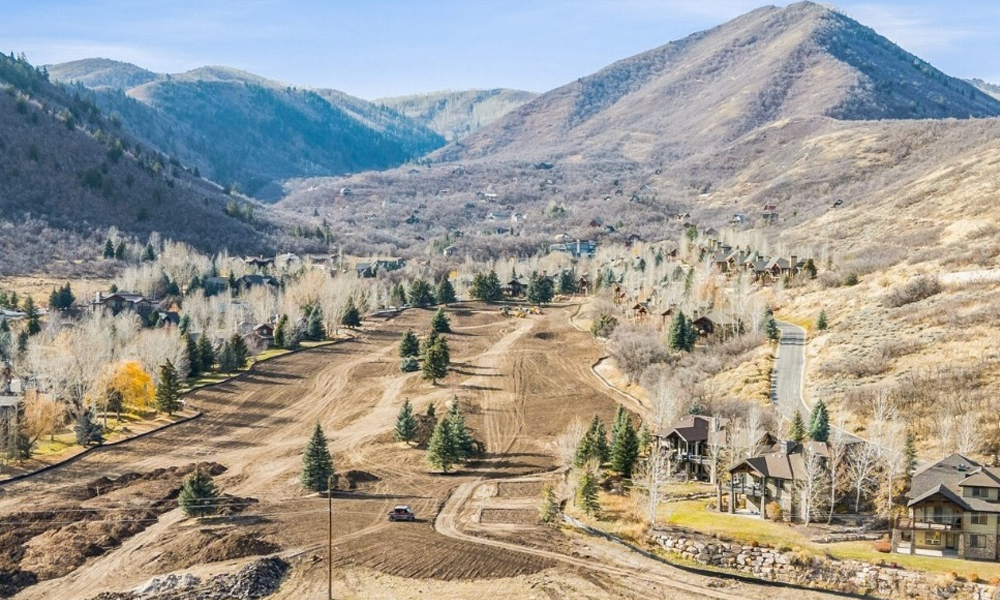
Homestead – A multi-million-dollar course renovation now underway here in Midway, Utah, is part of a major resort-wide enhancement. Originally designed by Bruce Summerhays, the course is undergoing a massive remodel overseen by John Fought. It involves redesigning all greens, fairways, bunker complexes and tee spaces; new irrigation system; improved cart paths and landscaping. Also involved are upgrades to the clubhouse, fitness center and six swimming pools. The resort is known for its mineral-rich, geothermal waters. A nearby tourist attraction is The Crater, a 400-foot-wide, 55-foot-tall beehive-shaped limestone dome. For more, visit https://homesteadmidwayutah.com/adventures/crater/.
Michael Keiser, the son of Mike Keiser, godfather of the wildly successful Bandon Dunes Golf Resort on the southern Oregon coast, is building similar venues in unlikely places. Expected to welcome golfers in 2027, the 4,000-acre Rodeo Dunes near Roggen, Colo., a town off Interstate 76 is about 50 miles northeast of Denver and a bit closer to Fort Collins and Colorado Springs. The project includes two 18-hole layouts by one of the Keiser’s preferred design teams, Bill Coore and Ben Crenshaw, with the other to be handled by their associate, Jimmy Craig. As is typical of Keiser’s preference for firm and fast conditions mimicking those in the UK, these layouts will occupy a sand-based landscape and be augmented by overnight units, eateries and related facilities. https://www.rodeodunes.com/.
Michael Keiser is also behind Old Shores in Vernon on Florida’s Panhandle. Construction is underway on the first Tom Doak course, with a second now in design phases. Also planned for the 5,000-acre property is Old Shores Village. This city-like community with homes, streets and retail establishments is a bit different than Keiser’s other golf-resort developments. https://oldshores.com/.
The initial eight holes of the first 18 at Keiser’s Wild Spring Dunes in east Texas opened for preview play in November 2025. The full layout will debut in fall 2026. Coore-Crenshaw has also routed a second course here and it’s now in pre-construction. The 2,400-acre site is situated about a 1.5-hour drive from Shreveport, La., and two and a half hours from the Dallas and Houston metroplexes. Upcoming plans include a clubhouse and lodge. Cottages and homesites are now available. https://www.wildspringdunes.com/.
David McLay Kidd – Last fall, the Kidd-designed course at Loraloma Golf Club & Estates (https://loralomaclub.com/) on the Pedernales River in Texas opened for members. Loraloma was followed a few months later by his Scarecrow 18 at Gamble Sands in Pateros, Wash., above the Columbia River.
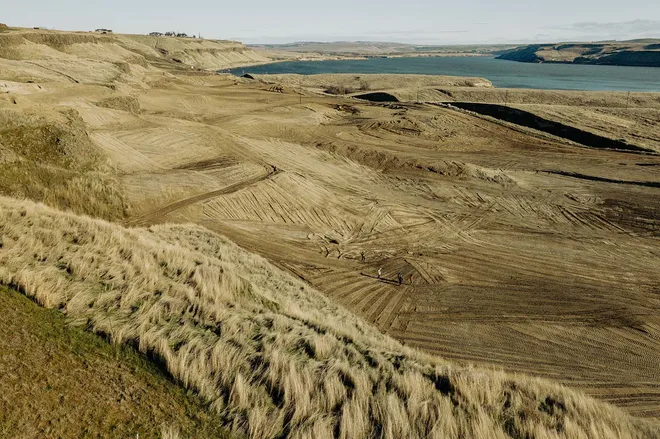
Now generating excitement in Washington state is River Ranch Golf Club in Pasco, 175 miles south of Gamble off Interstate 82. With this project, the Bend, Ore.-based Kidd, who flies his own plane to many jobsites, enjoys a short hop from his home. River Ranch sits on rocky tableland above the Snake River near its Columbia emergence on sandy soil. River Ranch occupies the former Gordon Estate Winery. Pasco – among the Tri-Cities with Richland and Kennewick – has hot summer temps and chilly but generally dry winters so golf can be played in these parts year-round. The incredibly low annual precipitation in this true desert section of the Evergreen State ranges from 5-9 inches.
Like the orchardist owners of Gamble Sands, the Gebbers, Kidd is working at River Ranch with Keith and Jordan Tiegs, whose family owns one of the largest farming operations (150,000 acres) in the Pacific Northwest. Tieg’s produce ends up in many supermarkets and restaurants across the United States.
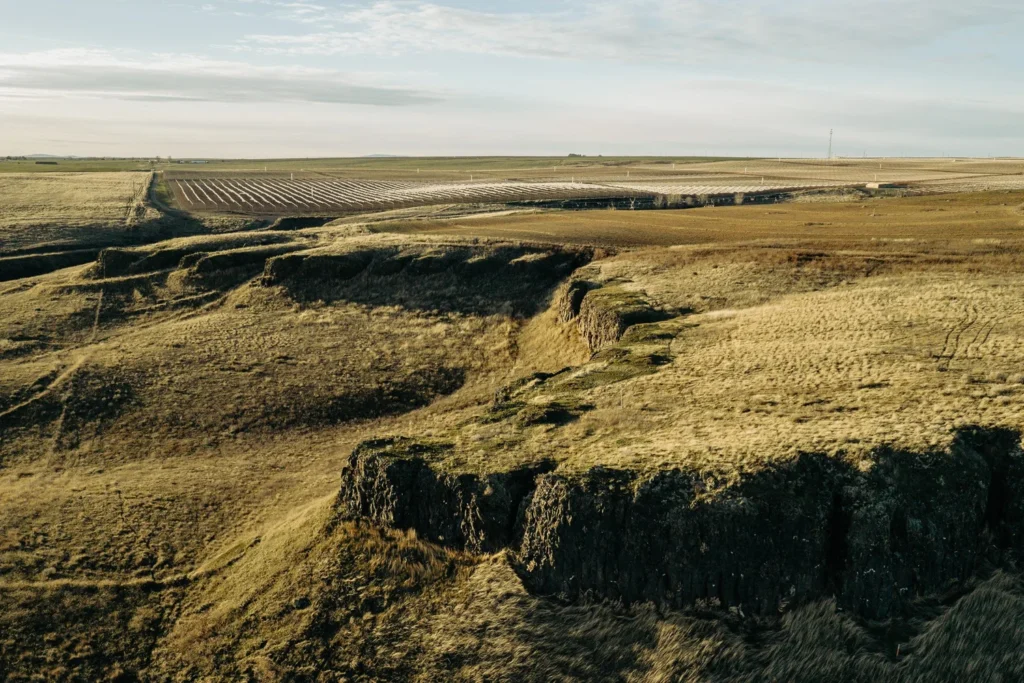
Regulars at Columbia Point GC in Richland, the golfing brothers got to thinking about their visually striking 320 acres perched 80 feet above the Snake. According to Golfweek’s Jason Lusk (https://golfweek.usatoday.com/story/sports/golf/2026/01/21/david-mclay-kidd-washington-river-ranch-golf-club-new-course-cliffs/88272582007/?a=a&utm_source=golfweek-getprimed-strada&utm_medium=email&utm_campaign=golfweek_baseline_greeting&utm_term=Untitled&utm_content=golfweek-8872SM-E-NLETTER36), the brothers told Kidd, “This land is too good for potatoes and houses, so what would golf look like here?”
Shaping began on five holes in November 2025. If all goes well with the fescue grassing, the public layout will open in summer 2027 along with four-bedroom cottages, a practice facility and clubhouse. There’s adjacent land for perhaps a second course and additional amenities. https://www.riverranchgolf.com/.
Jeff Shelley has written and published 12 books as well as numerous articles for print and online media since 1987. Among his titles are three editions of the book, “Golf Courses of the Pacific Northwest.” The Whidbey Island resident was editorial director of Cybergolf.com from 2000-15, co-founder of the Northwest Golf Media Association and president of the nonprofit First Green (https://www.thefirstgreen.org/). To contact Jeff: fairgreens@seanet.com.