There’s a phrase every golf course superintendent has heard at some point—usually from a well-meaning member or board representative:
“Why can’t our course look like Augusta?”
It’s a fair question. It’s also the wrong one.
Augusta National Golf Club has become the gold standard for turf conditions, visual presentation, and playing surfaces. But what often gets overlooked—especially outside the superintendent’s office—is that Augusta isn’t simply maintained. It’s engineered, curated, and timed to perfection in ways few facilities could realistically replicate.
For those in the business of managing turf, staff, budgets, and expectations, Augusta offers something far more valuable than inspiration: it offers context.
A Course Built on Horticulture, Not Just Golf
Long before it became golf’s most recognizable property, Augusta National sat on land known as Fruitland Nurseries—one of the most ambitious horticultural operations in 19th-century America. Plants were imported from around the world, tested, cultivated, and displayed.
That legacy still matters.
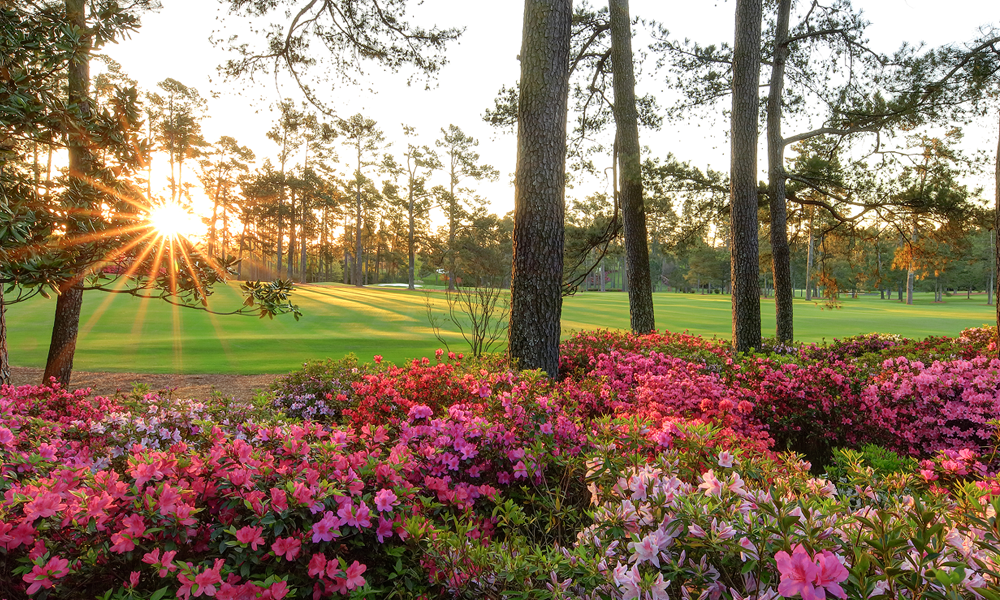
Today, the course’s famous visual identity—flowering corridors, layered vegetation, and seasonal color—isn’t simply decorative. It’s the result of a site that was always about plants first and golf second.
When Bobby Jones and Alister MacKenzie selected the property in the early 1930s, they weren’t starting from scratch. They were building on a landscape already optimized for plant diversity and growth.
For superintendents, that’s an important distinction. Augusta didn’t create ideal conditions—it inherited them.
Engineering Perfection
Augusta National’s playing surfaces are often described as “natural.” In reality, they are anything but.
The course operates on a carefully orchestrated agronomic system:
- Base turf: Bermudagrass throughout the property
- Seasonal overlay: Perennial ryegrass overseeded each fall on tees, fairways, and rough
- Greens: Bentgrass maintained at extremely low heights
Each year, the Bermudagrass is aggressively transitioned out and replaced with ryegrass, creating that iconic spring color and density. The process requires weeks of preparation, significant irrigation, and precise timing.
Then there’s moisture control.
Augusta’s SubAir system allows the agronomy team to regulate moisture beneath the greens—pulling water out or pushing air in as needed. The result? Consistent firmness and speed, regardless of weather.
Even mowing patterns are strategic. Fairways are often cut into the grain, subtly reducing rollout and influencing how approach shots behave. What appears visually simple is, in reality, highly calculated.
This isn’t maintenance. It’s environmental engineering.
The Superintendent’s Reality
It’s easy to assume Augusta’s success rests on a single exceptional superintendent. In truth, it’s a coordinated operation supported by a deep, highly skilled team—and often supplemented by top-tier agronomic talent from across the country during peak preparation periods.
Superintendents like Brad Owen have earned recognition for their leadership, but the real story is the system behind them:
- Expanded staffing levels
- Access to advanced technology
- A schedule built around a single peak performance window
And perhaps most importantly, time.
Augusta National closes for part of the year, allowing the course to recover, transition, and prepare without the daily wear most facilities must manage. That alone separates it from the reality of public, resort, and even most private courses.
The Illusion of Effortless Perfection
To the average golfer, Augusta appears flawless—uniform color, tight lies, pristine bunkers, and lightning-fast greens.
But that “effortless” look is anything but.
Behind it are:
- Intensive water usage and drainage systems
- Highly controlled mowing and fertility programs
- Imported materials (including pine straw and bunker sand)
- Continuous monitoring and adjustment of every surface
Even the course’s elevation changes—over 150 feet from high to low points—create microclimates that require tailored management strategies across different areas of the property.
In short, Augusta doesn’t eliminate variability. It manages it at a level few others can.
The Augusta Effect
Here’s where things get interesting—and where your readers will likely nod in recognition.
Augusta National has shaped golfer expectations worldwide. Its influence extends far beyond Georgia, into member conversations, board meetings, and budget discussions everywhere.
The result?
An industry-wide phenomenon sometimes jokingly referred to as “Augusta Syndrome”—the belief that every course should achieve Augusta-like conditions, regardless of resources, climate, or play volume.
For superintendents, this creates a familiar tension:
- Expectations driven by television and reputation
- Realities defined by staffing, funding, and weather
Augusta raises the bar. But it also moves the goalposts.
What Can Actually Be Learned
For all its uniqueness, Augusta National still offers valuable lessons—if viewed through the right lens.
Not as a blueprint, but as a benchmark of principles:
- ✔ Precision matters
Consistency in moisture, mowing, and inputs creates predictable playing conditions. - ✔ Agronomy supports strategy
Firmness, speed, and turf health aren’t just aesthetic—they shape how the course plays. - ✔ Timing is everything
Augusta’s success is built around peaking at the right moment, not maintaining perfection year-round. - ✔ Details define perception
Visual presentation—clean edges, uniform surfaces, thoughtful landscaping—goes a long way with golfers.
What doesn’t translate as easily:
- Unlimited resources
- Seasonal closures
- Large-scale staffing and infrastructure
Final Thought
Augusta National isn’t the model every course should try to replicate.
It’s the reminder of what’s possible under ideal conditions—and what’s required to get there.
For superintendents managing real-world operations, that distinction matters.
Because the next time someone asks, “Why can’t our course look like Augusta?”
The better answer might be:
“Let’s talk about what Augusta actually is.”